Updated 22-April-2026
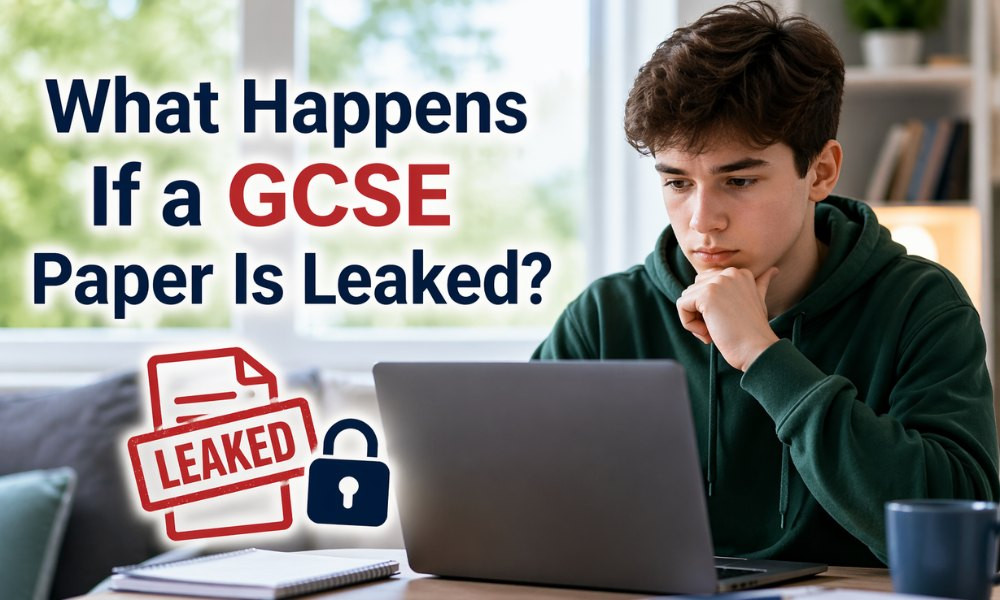
Every exam season, the same question appears again and again:
“What if the GCSE paper gets leaked?”
It’s easy to understand why students worry about this. You’ve spent months preparing, revising, and trying to stay focused — and suddenly, you hear rumours about a paper being leaked online.
It can feel unfair, stressful, and confusing.
But here’s the truth most students don’t realise:
Even if a leak happens, your result is almost always protected.
Exam boards in the UK are prepared for these situations. They have systems, backup plans, and strict rules to ensure that no student is unfairly advantaged or disadvantaged.
This guide explains exactly what happens — clearly, simply, and without panic.
GCSE exams are built on fairness.
Every student sits the same paper, under the same conditions, at the same time. That’s what makes your grade meaningful.
When a paper is leaked before the exam, it can break that balance. Some students may gain access to questions early, while others don’t. This creates confusion and anxiety, especially when students are already under pressure.
That’s why exam boards and Ofqual treat leaks very seriously.
In fact, even rumours of leaks can cause panic — and many of those rumours turn out to be completely false. Studies and reports show that most so-called “leaks” online are fake or scams rather than real exam papers.
One thing students often don’t realise is how quickly leaks are spotted.
Exam boards actively monitor social media platforms, websites, and messaging apps. They also rely heavily on reports from students, teachers, and schools.
If something suspicious appears online, it is flagged and investigated immediately. Schools are required to report any potential issues to the exam board as soon as possible.
At this stage, the first priority is simple:
Is it real — or just a rumour?
Many cases end here, because the majority of “leaked papers” are actually old papers or fake documents shared to mislead students.
If a leak turns out to be genuine, exam boards move very quickly.
Their first step is to assess how serious the situation is. They look at how widely the content has spread and whether it could give students an unfair advantage.
If only a small number of people saw the content, the exam may still go ahead as planned, with additional monitoring.
However, if the paper has spread more widely, the exam board can replace it completely. Backup papers are prepared in advance for situations like this, allowing exams to continue without disruption.
This means that even in the worst-case scenario, students still sit a valid exam.
This is the most important question — and the answer is reassuring.
If you were not involved in the leak, your results will not be affected.
Exam boards use statistical methods, including grade boundary adjustments, to ensure fairness across all students.
Even if different students sit different versions of a paper, the marking system is designed to keep everything balanced.
In fact, official reports show that even when security issues are investigated, there is usually no evidence that results are affected.
Resits are extremely rare and only considered if there is no other fair solution — which almost never happens.
While most students are protected, the situation is very different for those who are involved in leaking or accessing papers.
Exam boards and Ofqual treat this as malpractice.
Students who actively search for leaked papers, buy them, or share them can face serious consequences, including disqualification from the exam.
Even attempting to access leaked content can be risky.
This is why it’s important to stay away from anything that looks suspicious, no matter how tempting it might seem.
If you come across something that looks like a leaked exam paper, the best thing to do is stay calm and act responsibly.
The most important thing is to avoid interacting with it. Opening, sharing, or even discussing it can create problems, even if your intentions are not harmful.
Instead, report it to your school or exams officer. They will know how to handle the situation and inform the exam board if necessary.
Remember, exam boards are focused on protecting honest students — not punishing them.
If you ignore the leak and report it, you have nothing to worry about.
This is where a lot of confusion comes from.
Online, it can feel like leaks are happening all the time. Social media, group chats, and forums often spread rumours quickly.
But in reality, genuine leaks are rare.
Even when issues are reported, they are often small, accidental breaches or fake content being shared online.
From student discussions online, many also confirm that most “leaks” are scams or misinformation:
“The chances of real leaks are very low… most are scams.”
This means the biggest risk is not actual leaks — it’s panic caused by false information.
Exam boards have strict systems in place to prevent leaks from happening in the first place.
From the moment papers are created, they are handled under controlled conditions. They are securely stored, carefully transported, and only opened at the correct time.
Every step is monitored, and every person involved is trained to follow strict procedures.
There are also tracking systems in place to identify where papers have been and detect any unusual activity.
All of this is overseen by Ofqual, ensuring that standards are maintained across the entire system.
It’s easy to get distracted by rumours of leaks, especially close to exams.
But the reality is simple:
Leaks are rare, and the system is designed to protect you.
The biggest mistake you can make is losing focus because of something that is outside your control.
Instead of worrying about leaks, your time is much better spent on revision, practice papers, and improving your exam technique.
Because at the end of the day, your result depends on your preparation — not on rumours.
Can I get disqualified if I see a leaked paper?
No, accidentally seeing it won’t get you disqualified. But actively searching or sharing it can.
Will exams be cancelled if papers leak?
Usually no. Exam boards replace papers or adjust marking instead.
Do GCSE leaks happen often?
No, most “leaks” online are fake or scams.
Will I have to resit?
Almost never. Resits are extremely rare.
Should I report a leak?
Yes, always report it to your school or exam centre.
Hearing about a GCSE paper leak can feel stressful, but it’s important to stay calm and focus on the facts.
Exam boards are prepared for these situations, and they act quickly to keep everything fair. In almost all cases, students are not affected, and exams continue as planned.
You won’t be penalised for something you didn’t do. You won’t lose your results. And you won’t need to resit.
The best thing you can do is simple:
Ignore the rumours, avoid suspicious content, and stay focused on your preparation.
Because your hard work matters far more than anything else.
🔗 Helpful ResourcesPractise with GCSE past papers
Book your GCSE exams as a private candidate
Recent Posts
Categories
Tags